





Buying Wholesale Soursop Online: Calculating Yield Across Product Types

Understanding how to calculate yield when buying wholesale soursop (also known as graviola) online can make or break a good business decision—whether you’re a café owner, a small herbal brand, or simply sourcing for bulk personal use. Each soursop product type—pulp, dried leaves, freeze-dried powder, liquid extracts—varies in concentration and moisture, which means their actual usable yield per unit weight will differ. A clear grasp of conversion factors, processing losses, and sample checks helps buyers maximize both budget and storage, while ensuring consistent product quality for customers or recipes.
The Importance of Understanding Soursop Yield
Purchasing wholesale soursop is an investment in both quality and efficiency. When you know how each format converts into servings or usable product, you make more informed decisions about quantity, packaging, and budgeting. Let’s explore what yield means and why it matters.
- Yield refers to the amount of usable product derived from the purchased bulk soursop format. For businesses, yield directly impacts cost per serving, production planning, and even menu pricing.
- Format Differences are crucial because every format (pulp, leaf, powder, extract) comes with unique moisture content and concentration, leading to different conversion rates and handling processes.
- Avoiding Surprises by factoring in shrinkage, moisture loss, and necessary conversion helps you anticipate how much end product you’ll actually have—helping prevent both costly over-purchasing and disappointing shortages.
Overview: Soursop Wholesale Formats and Common Uses
Fresh or Frozen Soursop Pulp
- Typical Use: Smoothies, desserts, purees, beverages
- Moisture Content: Around 80–85%
- Key Points: Most of the weight is water; often shipped frozen for preservation
Dried Soursop Leaf
- Typical Use: Herbal infusions (tea), homemade extracts
- Moisture Content: 5–10% (dried)
- Key Points: Lightweight for shipping; requires steeping or extraction to yield a serving
Freeze-Dried Soursop Powder
- Typical Use: Capsules, drink powders, baking, smoothies
- Moisture Content: Typically 2–5%
- Key Points: Most concentrated form; easy to store; high yield per unit weight
For those seeking convenience in preparation and consistency in flavor and nutrient profile, products like Soursop Leaf Tea | Organic Graviola 24 Bags | Soursop Tea Benefits for Immunity & Wellness can simplify both ordering and yield estimation processes.
Soursop Liquid Extracts
- Typical Use: Drops for beverages, direct consumption, ready-to-use formulations
- Moisture Content: Not applicable; concentration varies (often specified as 4:1, 10:1, etc.)
- Key Points: Offers standardized servings per bottle or liter; always confirm concentration specs
How to Estimate Usable Yield for Each Soursop Format
Fresh or Frozen Soursop Pulp: Conversion and Considerations
- Estimate yield by moisture: With roughly 80–85% water, only 15–20% is concentrated pulp.
- Example: If you buy 10kg of fresh pulp, expect approximately 1.5–2kg of actual soursop solids.
- Serving estimation: A typical serving uses 100–150g of pulp (before blending with other ingredients).
- Processing loss: Consider 2–5% weight loss if thawing and draining excess water.
Tips:
- Always check for added sugar or preservatives which affect weight.
- Upon receipt, weigh a sample after thawing and draining to verify net usable content.
Dried Soursop Leaf: Estimating Servings
- Common serving: 1–3 grams (approx. 1 tablespoon) per cup of infusion.
- Bulk serving conversion: 1kg of dried leaf yields roughly 330–1,000 servings, depending on steeping strength.
- Processing loss: Minimal if stored properly; some weight loss may occur from stems or unusable bits (expect up to 5%).
Products such as the Soursop Leaf Graviola Extract 15X Liquid | Organic Cell & Immunity offer a concentrated liquid format that helps users standardize servings and minimize guesswork for infusions and extracts.
Tips:
- Request a test lot to check leaf cut size and absence of excess stem.
- Store in airtight containers to preserve aroma and volatile compounds.

Freeze-Dried Soursop Powder: Maximizing Yield
- Concentration: 1kg of freeze-dried powder may represent 8–10kg of raw fruit.
- Typical serving: 2–5 grams for drinks or capsules.
- Bulk yield: 1kg powder can produce 200–500 servings, depending on serving size.
- Processing loss: Very low if kept dry; watch for powder settling or clumping.
For capsule and extract formats, Soursop Graviola Leaf Extract Capsules 10X | 60ct – Cell & Immunity provide dosing consistency for businesses formulating for daily wellness.
Tips:
- Check supplier’s reconstitution ratio (e.g., “add 1g powder to 9g water = 10g of original pulp”).
- Calculate storage space—powder is extremely compact compared to pulp or leaves.
Soursop Liquid Extracts: Converting Strength Into Servings
- Label concentration: Look for ratios like 4:1 or 10:1, meaning X grams of raw soursop condensed into 1g of extract.
- Serving size: Commonly 1–2ml per serving (check manufacturer specs).
- Bulk yield: 1 liter of extract at a 10:1 ratio could provide approximately 500–1,000 servings, depending on recommended dose.
- Processing loss: Some sediment or color changes can occur over time—monitor expiry dates.
To get the most from your soursop extract, measuring by the recommended serving size and confirming the concentration of the Soursop Leaf Graviola Extract 15X Liquid | Organic Cell & Immunity can help with planning and yield calculations.
Tips:
- Always review the concentration on your purchase documentation.
- For new suppliers, request a COA (Certificate of Analysis) confirming consistency.
- Use a graduated dropper or precise measuring tools for serving accuracy.

Practical Worksheets: Planning Your Soursop Wholesale Order
For cafes, brands, or buyers, calculating how much product you need is easier with a basic worksheet or checklist. Here’s a stepwise method:
- Specify Your Format(s): Choose from pulp, leaf, powder, or extract based on your recipes or product line.
- Determine Average Serving Size: Base this on your intended use—smoothie, tea, capsules, or drinks.
- Calculate Number of Servings Needed: Weekly, monthly, or per-batch requirements.
- Check Conversion Factors: Use supplier guidelines or the estimates above as a starting point.
- Adjust for Processing Loss: Account for spoilage, moisture loss, or remnants after processing—add 5–10% buffer.
- Order Extra for Sample Checks: Purchase enough for initial testing before committing to very large lot sizes.
- Plan Storage: Confirm you have dry, cool, pest-free storage for each format. Powders and leaves require different storage from pulp or liquid extracts.
To further streamline planning, products sold in standardized portions, such as Soursop Leaf Tea | Organic Graviola 24 Bags | Soursop Tea Benefits for Immunity & Wellness, make inventory management for busy cafes and wellness brands easy.
Planning to source wholesale soursop for your business? Join the Herbal Goodness wholesale program to access bulk pricing, business-friendly order options, and premium organic botanicals for your café, retail store, or wellness brand. Sign up to become a Herbal Goodness wholesaler and explore products designed for growing businesses.
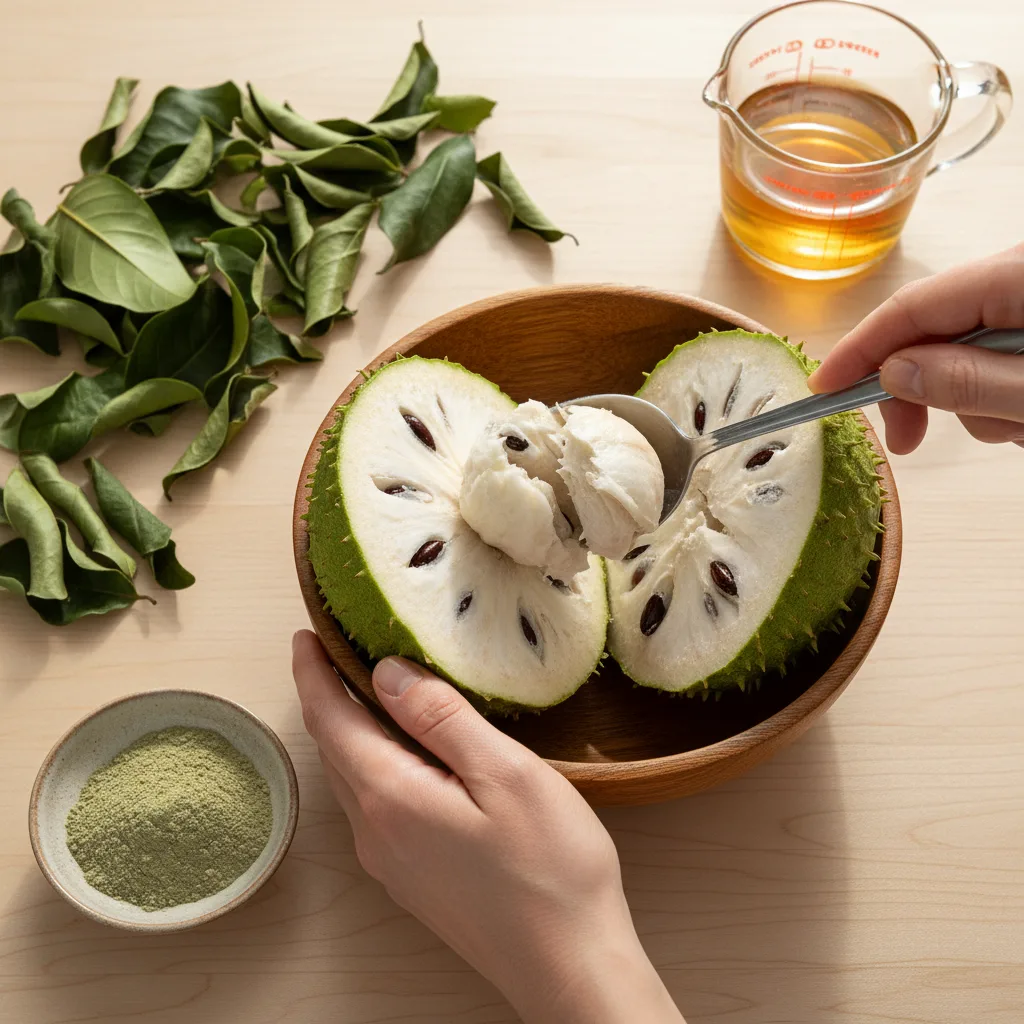
Sample Calculation (Soursop Powder for Smoothies)
- Target: 1,000 servings/month at 3g per serving
- Total needed: 3,000g (3kg) powder (plus buffer for sampling/testing: 10% = +300g)
- Order size to consider: At least 3.3kg per month
- Storage: High-quality sealable containers; cool, dark environment
Sample Size Checks: Why and How to Request Them
Wholesale soursop quality and yield can vary greatly depending on supplier practices, harvest timing, and processing methods. Before committing to a large order:
- Request a small test lot or sample pack of your intended format.
- Test for actual yield by weighing after any reconstitution or preparation step (e.g., after rehydrating powder, brewing leaves, thawing pulp).
- Evaluate aroma, flavor, and texture with your usual recipes or formulations.
- Document all sample results for easy comparison between suppliers.
- Ask for Certificates of Analysis or lab test summaries for bulk powders and extracts, especially for larger investments.
Selecting capsules such as Soursop Bitters Graviola Capsules 1000mg | 120ct – Immunity & Detox can be a smart move for those needing fast, portable, and accurately dosed options for consistent quality control between batches.
Handling Processing Losses and Maximizing Yield
No matter the supplier or product format, some degree of loss is expected from shipping, handling, or even day-to-day prep. Here’s how to minimize surprises:
- Moisture Variation: Especially with pulp and leaf, ambient humidity or freeze/thaw cycles can shift actual yield.
- Fragmentation: Dried leaves and powders can leave behind stem or excess dust—factor this out of net usable weight.
- Sediment in Extracts: Liquid products might form slight sediment due to natural plant compounds; gentle shaking or decanting can help.
- Best Practices: Always use scales, volumetric measures, and check-pack sizes on arrival before storing all bulk lots.
Bulk formats like Soursop Graviola Leaf Extract Capsules 10X | 60ct – Cell & Immunity and Soursop Bitters Graviola Capsules 1000mg | 120ct – Immunity & Detox enable portion control and long shelf life, which helps with reducing waste.
Sourcing and Storing for Consistent Usable Yield
-
Sourcing: Choose reputable suppliers like Herbal Goodness that clearly state concentration, moisture content, and processing standards.
-
Storage Tips:
-
Keep powders and leaves in airtight containers away from light.
-
Store liquid extracts as instructed, often refrigerated after opening.
-
Frozen pulp should remain solid until just before use, then drained and swiftly used.
-
Stock Turnover: For maximum quality and yield, buy only what can be used within a reasonable period, which may vary for each format (3–12 months is typical).
By considering these conversion rates, handling factors, and best practices, you can confidently plan and order wholesale soursop, optimizing both your investment and the quality of your finished products.
Once you've calculated your expected yield and determined the right product format, the next step is choosing a supplier you can rely on. Sign up to become a Herbal Goodness wholesaler to access premium organic soursop products, wholesale purchasing opportunities, and business support tailored for retailers, cafés, and wellness brands.
FAQs:
- How do I estimate the number of servings from wholesale soursop pulp?
Estimate servings based on the average serving size (about 100–150g per smoothie or recipe). A 10kg frozen pulp lot contains mostly water (80–85%), so expect around 65–100 servings depending on how it’s processed and served.
- What is the conversion ratio for dried soursop leaf to tea servings?
Typically, 1–3 grams (about 1 tablespoon) of dried leaf yields one cup of soursop tea. One kilogram of dried leaf can produce 330–1,000 servings depending on the desired infusion strength.
- How do I convert bulk soursop powder into finished servings?
Check supplier guidelines for serving size, usually 2–5 grams per serving. One kilogram of freeze-dried powder generally yields 200–500 servings, as it’s highly concentrated.
- How can I verify the actual yield from different soursop suppliers?
Request small sample lots for each format. Prepare a sample per your methods and weigh the end product. Compare this with the supplier's stated conversion rate to confirm consistency before placing a larger order.
- What should I look for in a soursop extract when planning order sizes?
Review the concentration ratio (such as 10:1 or 4:1) and recommended serving size on the label. Calculate number of servings per liter, and always consider potential sediment and expiry shelf-life for optimal yield.
- What storage tips help preserve the usable yield of soursop formats?
Store dried leaf and powder in airtight containers in a cool, dry place. Keep frozen pulp solid until use, and store liquid extracts according to manufacturer recommendations, usually in refrigeration after opening.
- How can I account for processing losses in my soursop yield calculations?
Add 5–10% as a buffer to your planned quantity to cover losses from moisture variation, minor spoilage, or removal of non-usable parts.
Author Name:
Herbal Goodness Editorial Team
Author Bio:
The Herbal Goodness Editorial Team specializes in holistic health and superfoods, blending science and nature to educate and empower our community.
References:
Introducing Graviola to Young Taste Buds: Fun, Family-Friendly Flavor Exploration
Graviola in the Classroom and at Home: Creative Activities to Teach Kids About Tropical Plants
Share this
Popular posts


FAQs
1. What are the main benefits of drinking bamboo leaf tea?
Drinking bamboo leaf tea supports hydration, relaxation, skin wellness, and antioxidant balance.
2. What is bamboo leaf extract used for?
It’s used for general body wellness, skin elasticity, hair and nail support, and overall vitality.
3. Can bamboo leaf help with skin care and body wellness?
Yes, bamboo leaf is rich in silica and antioxidants, which promote healthy skin, strong nails, and a youthful glow.
4. What forms of bamboo leaf are available?
You can find dried bamboo leaf, powder, extract, drops, oil, and bamboo leaf green tea.
5. Are there any side effects of bamboo leaf?
Bamboo leaf is generally safe when consumed in moderation. Always consult your healthcare provider before starting any new herbal supplement.